Shingles Cracking and Curling Fast at High Altitude? What UV Does
October 13, 2026
Weak Attachment Methods
Maintenance and Inspection After Installation
Even high-quality gutter systems require routine maintenance to function properly. Leaves, twigs, roofing granules, and debris can block water flow and create overflow problems during storms. Clogged gutters place additional weight on the system and increase the risk of sagging or separation.
Seasonal cleaning helps maintain proper drainage and allows homeowners to identify early signs of wear. Areas surrounded by trees often require more frequent maintenance because debris accumulates faster throughout the year.
Gutter guards may help reduce maintenance needs, but no system completely eliminates the need for inspections. Professional evaluations help ensure hidden issues are identified before they develop into larger structural concerns.
Regular Cleaning Supports Performance
Identifying Early Warning Signs
Routine inspections help detect small problems before major water damage occurs. Common warning signs include peeling paint, rust spots, overflowing water, sagging sections, and moisture stains near exterior walls.
Water marks beneath the gutters often indicate leaks or improper alignment. Pools of water near the foundation after rainfall may suggest downspout discharge issues or insufficient drainage capacity. Addressing these concerns early helps extend gutter lifespan while reducing repair costs.
Homeowners should also inspect attic and basement areas for signs of moisture intrusion linked to drainage failures. Early intervention prevents minor gutter issues from escalating into widespread structural damage.
This is paragraph text. Click it or hit the Manage Text button to change the font, color, size, format, and more. To set up site-wide paragraph and title styles, go to Site Theme.
Frequently Asked Questions
Why do ice dams keep forming in the exact same spot every year?
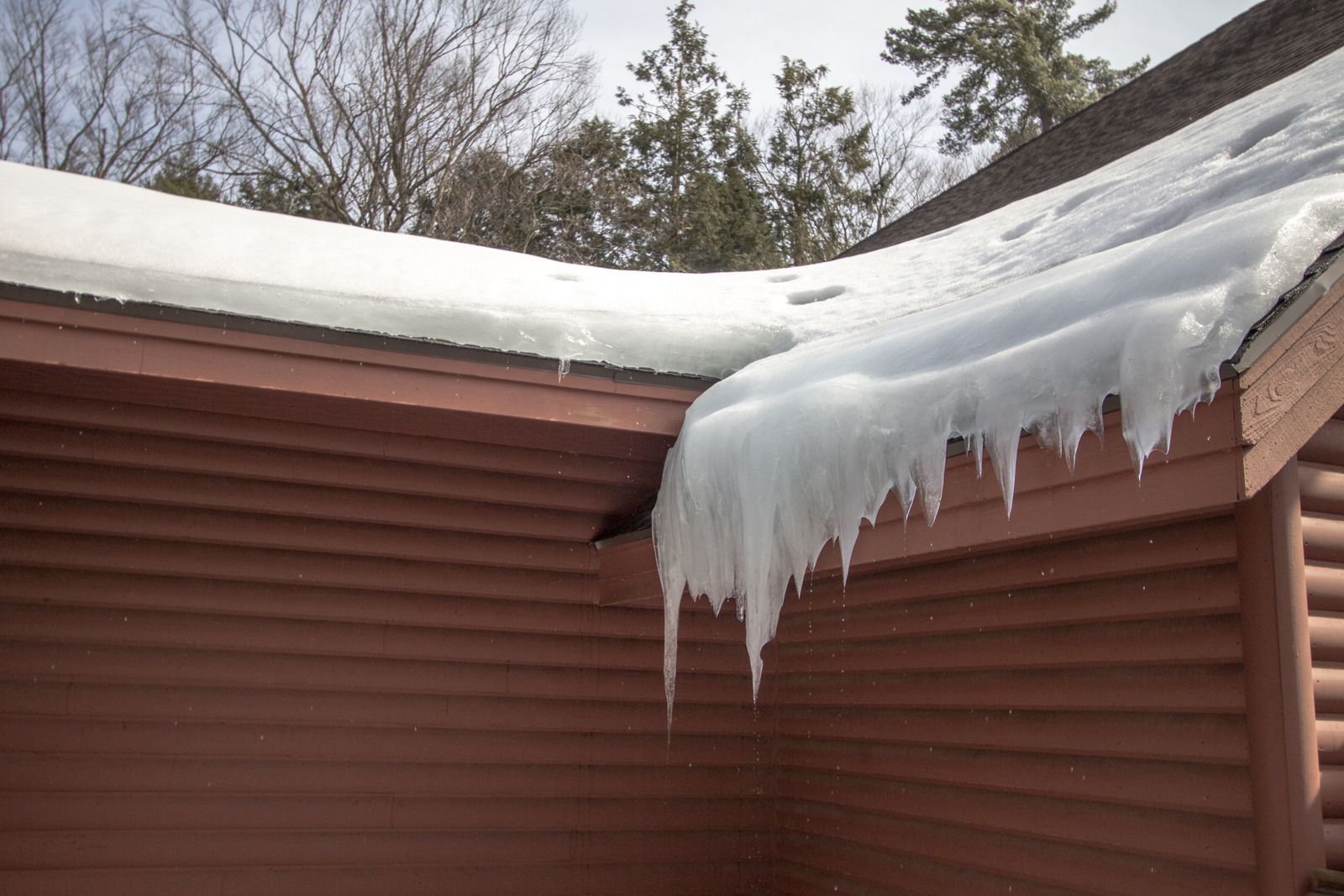
Ice dams return in the same locations because the same heat loss pattern remains. Warm attic areas melt snow above cold eaves, creating repeated freezing points. The location reveals where insulation or air sealing may need improvement.
Are ice dams caused by my gutters or my shingles?
No, gutters and shingles do not create ice dams. They may suffer damage from them, but the cause is uneven roof temperatures from attic heat loss. Proper insulation, ventilation, and air sealing address the actual problem.
Does removing the snow from my roof fix the problem?
Removing snow can temporarily reduce ice dam formation by eliminating water sources. However, it does not correct heat loss or attic issues. Proper air sealing, insulation, and ventilation are needed to prevent recurring winter problems.
Will adding more roof vents get rid of my ice dams?
Adding vents alone will not eliminate ice dams. Effective ventilation requires balanced airflow between soffits and ridge vents. Combined with proper insulation and air sealing, it helps maintain consistent roof temperatures and reduce freezing issues.
Are icicles hanging off my gutters a sign of an ice dam?
Large icicles near gutters can indicate melting snow refreezing at cold roof edges. While not always proof of damage, they often signal heat escaping through the attic and uneven roof temperatures that contribute to ice dams.
Why does my house get ice dams when my neighbor's doesn't?
Ice dams depend on attic conditions, not just weather. Differences in insulation, ventilation, and air sealing affect heat loss. A warmer attic melts snow faster, while a properly insulated home maintains colder roof surfaces and avoids dams.
Quick Answer: Shingles crack and curl early at high altitude because the thin air filters out less ultraviolet light, so the asphalt bakes harder and loses the oils that keep it flexible. Add daily temperature swings of 30 or 40 degrees, a hot attic pushing heat up through the deck, and a south facing slope that takes the worst of the sun, and the shingle goes brittle from the surface down. Curling usually shows up first along edges and on the sunniest slopes, while cracking follows as the asphalt dries out. Poor attic ventilation and dark colors speed all of it up. A roof that looks fine from the driveway can already be well into this process, so a close look at the sunniest slope tells you the most.
You pull into the driveway on a clear October afternoon and notice something you did not see last year. A few shingles along the south edge of the roof have lifted at the corners, like the pages of a damp book. Closer up, with binoculars or from a ladder at the eave, the surface looks dull and dry. There are hairline cracks running across the tabs, and the gutter has a thin layer of dark grit at the downspout that was not there before.
Your roof is not old enough for this, at least by the label on the bundle. Maybe it is twelve years in, maybe fifteen, and the warranty paperwork promised a good deal more. If you live in the Gallatin Valley, up around Big Sky, or anywhere in the mountain country of southwest Montana, you are not imagining things. Shingles age faster here than the brochure suggests, and the reasons are specific, measurable, and mostly about sunlight.
Why High Altitude Is Hard on Asphalt
An asphalt shingle is a fiberglass mat soaked in asphalt and covered with mineral granules. The asphalt is the waterproofing. The granules are the sunscreen. As long as the granules stay put, the asphalt underneath stays shaded and stays flexible.
Ultraviolet radiation is the force that wears that arrangement down, and altitude matters because there is less atmosphere above you to absorb it. Inspection professionals who study roof weathering list elevation as one of the main factors in how fast shingles age, noting that homes at higher elevations take more UV exposure, which deteriorates most roof coverings, asphalt included. Bozeman sits at roughly 4,800 feet. Big Sky is closer to 7,500. Every thousand feet you climb, the sun hits your roof a little harder.
Light Does The First Damage
Ultraviolet radiation breaks down asphalt's chemical bonds, causing oxidation and stiffness. Years of mountain sunlight make shingles brittle, reducing their flexibility significantly.
Heat Makes It Worse
Summer roof temperatures drive off volatile oils that keep asphalt flexible. Once these oils disappear, shingles become brittle, absorb moisture, and deteriorate.
Altitude Also Means Thin Air At Night
Clear, dry mountain air loses heat quickly after sunset. Roofs experience dramatic temperature drops, increasing stress on already weathered shingles and materials.
The Daily Swing That Pulls Shingles Apart
Many Montana valleys see swings of 30 or 40 degrees between an afternoon high and an overnight low, and spring and fall can be even more dramatic. Every one of those swings makes the roofing expand and contract. Shingles, the deck beneath them, and the nails holding everything together all move at slightly different rates.
One cycle does nothing you could see. Thousands of cycles do. Inspectors who document shingle failure describe thermal cycling as a leading cause of splitting, because the shingle contracts or the deck beneath it contracts, and a shingle that has already lost its flexibility cannot absorb the movement. The first signs are tiny surface cracks. Over a few seasons they widen, connect, and start exposing fresh asphalt to even more UV.
In cold weather there is a second layer to it. Moisture that finds its way into those surface cracks freezes and expands, prying them wider every time the temperature drops below freezing. A shingle in Bozeman can go through that cycle on dozens of nights each winter.
Tip: Photograph your south and west slopes each October from the same spot on the ground. Seeing the same shingles year after year makes it much easier to spot new curling or cracking than trying to remember what the roof looked like last fall.
Curling and Cracking Are Not the Same Problem
People use the two words interchangeably, but a roofer reads them differently, and the difference tells you what is going on.
Curling
There are two common forms. Clawing is when the tab edges lift upward and the center stays flat, giving the shingle a dished look. Cupping is the reverse, with the edges turned up like a shallow bowl. Both usually point to one of three causes: heat and moisture trapped under the shingle from poor attic ventilation, a moisture imbalance between the top and underside of the shingle, or aged asphalt that has dried and shrunk unevenly.
Curling that appears across a whole slope, especially a sunny one, points to age and heat. Curling in patches points to local problems such as a bad nailing pattern, a section with different ventilation, or shingles from a different bundle.
Cracking
Cracks that run across the tab or form a random network of hairlines, sometimes called crazing, are what asphalt does when it has lost its oils and can no longer stretch. This is a sign that the shingle has moved into the accelerating stage of its aging. Splits that run down from the top edge of the tab, or along the line of a nail, often point to thermal movement of the deck or shingles being fastened too tight to move.
Both together mean more. If you see both on the same roof, treat it as a pattern, not a coincidence. Curling opens the door for wind to get under shingles, and cracking opens the door for water. Together they shorten the useful life of a roof quickly.
Granule Loss: The Warning Sign Hiding in Your Gutter
The granules on a shingle are what shield the asphalt from UV. Some loss is normal, especially in the first year after installation as excess granules wash off. After that, steady loss means the bond between granules and asphalt is weakening. As the asphalt dries out and the oils leave, it grips the granules less tightly, and each rain, hail event, or snowslide carries more of them away.
Once granules thin out, UV reaches the asphalt directly, and the whole process speeds up. A patch of bare asphalt ages faster than the covered shingle next to it, which is why you sometimes see dark, glossy bare spots on sun exposed slopes while the shaded side still looks fine.
Here is where to check without climbing anything:
Look At The Downspout Outlets
A few granules are normal, but recurring piles in gutters or splash zones suggest shingles are losing protective coverage.
Look At The Shingle Surface
Shiny or darker streaks along shingle tabs and exposed edges can indicate granule loss and underlying asphalt exposure.
Compare Slopes
If the south-facing slope looks more worn than the north side, sunlight and heat likely contribute to deterioration.
What Makes Your Roof Age Faster Than the Neighbor's
Two houses on the same street can have shingles of the same age and very different condition. A few factors explain most of the gap.
Slope Orientation
South- and west-facing slopes receive stronger sunlight and greater temperature swings, while flatter pitches retain water longer and often deteriorate faster.
Color
Dark shingles absorb more heat, accelerating oil loss and thermal cycling. Lighter shingles generally experience less heat stress under comparable sunny conditions.
Attic Ventilation
Poor ventilation traps summer heat and winter moisture beneath the roof. Balanced soffit intake and ridge exhaust help regulate temperatures and extend shingle lifespan.
Shingle Quality And Installation
Lower-grade shingles lose oils faster, while improper nailing allows lifting. Poor underlayment increases water penetration risks when shingles fail.
Maintenance
Debris, moss, and clogged valleys trap moisture against roofing materials, accelerating cracking and curling, particularly in shaded areas with limited sunlight.
Warning: Do not walk on a roof that is curling or cracking, especially in cold weather. Brittle shingles break under foot and can send you sliding, and the damage you cause will open the roof to leaks. Use binoculars from the ground or hire someone with the proper safety gear to look.
Quick Answer: Most residential roofs are engineered to carry somewhere between 20 and 40+ pounds of snow per square foot, and in Bozeman city limits the current design roof snow load is 41 psf, with Gallatin County ranging from roughly 20 psf in the valley to nearly 96 psf at higher elevations. As a rough field estimate, 40 to 45 inches of fresh, dry snow or about 20 inches of wet, settled snow can approach that 20-psf danger threshold cited by structural engineers, and one inch of ice weighs about the same as a foot of fresh snow. The load on your roof matters less than how evenly it sits, so drifting, valleys, and ice buildup can push a roof past its limit long before the snow depth looks alarming. Sagging rooflines, sticking doors, new drywall cracks, and creaking under load are the signs that mean it is time to call a professional rather than watch and wait.
You walk out to the driveway after a three-day storm and notice the snow on your roof now stands taller than the snow on the ground. Wind pushed a drift up along the north slope overnight. The gutters have vanished under it. Somewhere beneath all that white, your trusses and rafters are doing the actual work of holding it up, and standing on the ground, you have no real way of knowing whether they're handling it fine or getting close to their limit.
That's the question every roof answers quietly, all winter long: how much weight can it take before something gives. The number isn't the same for every house. And it's rarely the total depth of snow that matters most — it's what that snow turned into by the time it settled. Here's how to actually read your roof's load instead of guessing at it.
Weak Attachment Methods
Maintenance and Inspection After Installation
Even high-quality gutter systems require routine maintenance to function properly. Leaves, twigs, roofing granules, and debris can block water flow and create overflow problems during storms. Clogged gutters place additional weight on the system and increase the risk of sagging or separation.
Seasonal cleaning helps maintain proper drainage and allows homeowners to identify early signs of wear. Areas surrounded by trees often require more frequent maintenance because debris accumulates faster throughout the year.
Gutter guards may help reduce maintenance needs, but no system completely eliminates the need for inspections. Professional evaluations help ensure hidden issues are identified before they develop into larger structural concerns.
Regular Cleaning Supports Performance
Identifying Early Warning Signs
Routine inspections help detect small problems before major water damage occurs. Common warning signs include peeling paint, rust spots, overflowing water, sagging sections, and moisture stains near exterior walls.
Water marks beneath the gutters often indicate leaks or improper alignment. Pools of water near the foundation after rainfall may suggest downspout discharge issues or insufficient drainage capacity. Addressing these concerns early helps extend gutter lifespan while reducing repair costs.
Homeowners should also inspect attic and basement areas for signs of moisture intrusion linked to drainage failures. Early intervention prevents minor gutter issues from escalating into widespread structural damage.
This is paragraph text. Click it or hit the Manage Text button to change the font, color, size, format, and more. To set up site-wide paragraph and title styles, go to Site Theme.
Can You Slow It Down or Do You Replace It
It depends on how far along the roof is, and an honest inspection settles it better than any rule of thumb.
If curling and cracking are limited to a few shingles, often along a single sunny slope, a repair can be reasonable. That means replacing the damaged shingles, resealing tabs that have lifted but remain flexible, and checking the flashing and nail pattern around them. The condition of the surrounding shingles matters, though. Brittle shingles around a repair tend to crack when they are lifted, so a patch on an old roof sometimes turns into a larger job than it appeared at first.
If the damage is widespread, if granule loss exposes the mat in many places, or if shingles break when handled, the roof has reached the end of its service life no matter what the calendar says. At that point the question is no longer whether to replace it, but when, and the better answer is usually before the next heavy snow rather than after.
When the time does come, a few decisions help the next roof last longer in this climate. Improving attic ventilation at the same time as the reroof addresses the heat that aged the old one. Choosing a lighter shingle color on the sunniest slopes reduces the heat load. Architectural shingles with thicker mats and better granule adhesion hold up to UV and temperature swings better than lighter grades. And correct installation, with proper nailing and a solid underlayment, matters as much as the shingle itself.
Timing Matters in Fall
October is a good time to deal with this, and not only because winter is coming. Shingles are still warm enough in the afternoon to be pliable, which makes repairs and sealing easier and reduces the chance of cracking brittle tabs. A roof that goes into winter with lifted corners and exposed asphalt takes on moisture, freezes, and starts the prying cycle early. By spring snowmelt, small problems have turned into leaks.
A fall inspection also gives you a clear picture of what the roof will need over the next few years. That way you can plan a repair or replacement on your schedule, instead of reacting to a drip in February.
Frequently Asked Questions
Why are my shingles curling after only ten or twelve years?
At altitude, UV, heat, and large daily temperature swings all speed up aging, with poor ventilation and dark colors adding more. A roof rated for a mild climate fails sooner here.
Is shingle curling a sign that I need a new roof?
Not always. A few curled shingles on one slope may be repairable. Curling across a whole slope, with cracking and heavy granule loss, usually means the roof is near its end.
Does UV really damage shingles that much?
Yes. UV breaks down the asphalt and makes it oxidize and stiffen, and the effect grows with elevation. The granule layer protects the asphalt, so aging speeds up once granules wear away.
Why do the south facing shingles look worse than the rest?
South and west slopes get more direct sun and bigger temperature swings, so they age faster. It is common for one slope to need attention years before the others do.
Can better attic ventilation fix curling shingles?
It will not reverse existing damage, but it slows further aging by keeping the deck cooler in summer and drier in winter. Correcting it during a reroof protects the new shingles.
What are the first signs of UV damage I can spot from the ground?
Look for dull or faded patches, shiny bare spots, lifted tab corners, and granules collecting at the downspouts. Photographing the same slopes each fall helps you track changes over time.
Should I wait until spring to deal with cracked shingles?
Waiting through winter lets moisture seep into cracks and freeze, widening them. Shingles also work more easily in fall than in deep cold, so fall is the better time to act.
Reading the Warning Signs Before Winter
Shingles that crack and curl early in Montana are not a sign that you chose the wrong roof or that something went wrong at installation. They are what asphalt does when it spends years under thin air, strong sun, and big temperature swings. The good news is that the warning signs appear well before the roof fails, and you can read them once you know where to look. Check the sunny slopes, watch the downspouts, and pay attention to how the attic breathes.
Catching the pattern early is what turns a forced repair into a decision you get to make on your own schedule, with the snow still weeks away. Iron Horse Exteriors
has spent more than 15
years inspecting and replacing roofs across Bozeman, MT, and the surrounding valleys, learning how high altitude UV and sharp daily swings age a shingle from the surface down. That experience is what separates a roof you can still plan around from one that surprises you in February.